
Let’s be honest. For decades, software testing has felt a bit like… well, searching for a needle in a haystack with your eyes closed. You have a plan, you have a team, but the sheer scale and complexity of modern applications—think microservices, constant updates, multiple platforms—is overwhelming. Manual testing is slow. Traditional automation, while faster, is brittle. It’s a constant game of catch-up.
Here’s the deal: a fundamental shift is happening. It’s not about replacing testers. It’s about augmenting them with intelligent allies. We’re moving from scripted automation to AI-augmented software testing, and ultimately, toward something even more profound: autonomous quality assurance. This is the quiet revolution reshaping how we ensure software quality.
What Exactly Are We Talking About? AI-Augmented vs. Autonomous
First, let’s clear the air. These terms get tossed around a lot. They’re related, but they’re different stages on the same spectrum.
AI-Augmented Testing: The Super-Powered Co-Pilot
Think of AI-augmented testing as giving your QA team a super-powered co-pilot. The human is still firmly in the driver’s seat, making strategic decisions. The AI handles the heavy, repetitive lifting and provides incredible insights. It’s like having a tireless, hyper-observant partner.
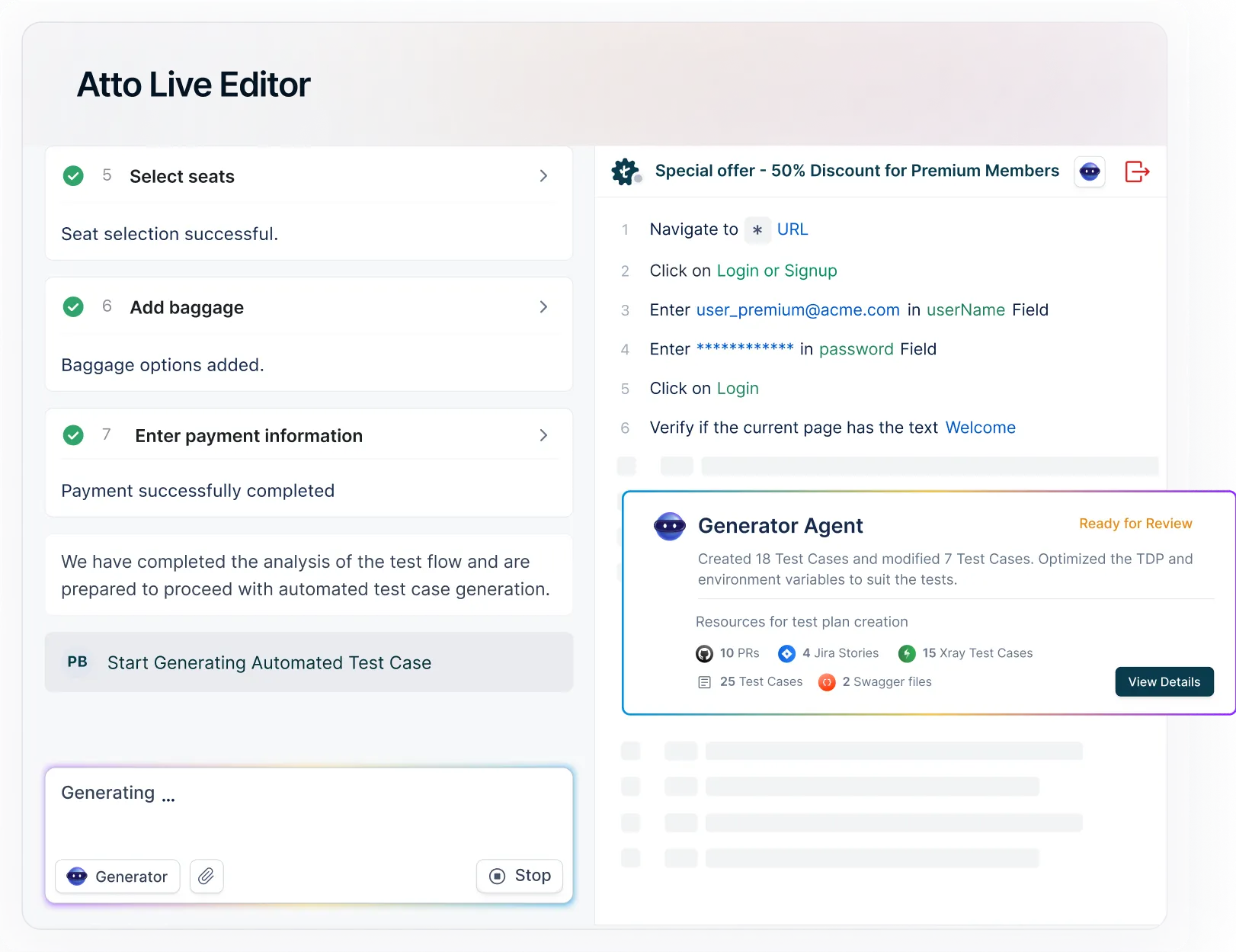
What does this look like in practice? Well, AI can automatically generate test cases by analyzing user stories and past data. It can prioritize which tests to run based on risk—like if you changed a core payment module. It can even visually validate UI elements across browsers and devices, spotting a misaligned button that a human might miss after the hundredth screenshot. The goal here is enhancement, not replacement.
Autonomous Quality Assurance: The Self-Driving Car of Testing
Now, autonomous QA—that’s the north star. This is where the system can, with minimal human intervention, self-heal, self-adapt, and self-execute the entire testing lifecycle. It’s the self-driving car metaphor applied to quality.
An autonomous QA system might monitor application behavior in production, learn what “normal” looks like, and then design and run tests to probe for anomalies—all on its own. If a UI element changes and a test script breaks, the system doesn’t just fail; it intelligently updates the script to match the new interface. It’s a continuous, self-sustaining loop of quality validation. We’re not fully there yet across the board, but pieces of this future are already in operation.
The Tangible Benefits – Why Bother?
Sure, it sounds futuristic. But the benefits are brutally practical today. Adopting AI in your testing strategy tackles the biggest pain points head-on.
| Pain Point | How AI/Autonomous QA Helps |
| Slow Test Creation & Maintenance | AI generates and updates tests, cutting script maintenance time by up to 70% in some cases. |
| Incomplete Test Coverage | Analyzes code and user paths to find untested “blind spots” you didn’t know existed. |
| Flaky, Unreliable Tests | Distinguishes between a real bug and a test environment hiccup, reducing false alarms. |
| Overwhelming Volume of Data | Processes 1000s of test logs and screenshots to pinpoint the root cause of failure instantly. |
| Releasing Under Pressure | Provides intelligent risk-based assessments, so you know what’s truly safe to release. |
Honestly, the biggest win might be morale. Freeing your test engineers from monotonous, repetitive tasks allows them to focus on what humans do best: complex scenario design, exploratory testing, usability assessment, and strategic thinking. It elevates the entire QA role.
Getting Started: A Realistic Adoption Roadmap
Okay, you’re convinced this is the direction to go. But you can’t just flip a switch. Transitioning to AI-augmented software testing is a journey. Here’s a no-nonsense approach.
- Audit Your Current State. Look at your existing test suites. Where is the most pain? Is it script maintenance? Visual regression? Test case design? Start there.
- Pick a Pilot Project. Don’t boil the ocean. Choose a single application or a specific testing type (like API testing or visual validation) for a proof-of-concept.
- Select Tools That Integrate. The market is growing fast. Look for solutions that plug into your existing CI/CD pipeline (Jenkins, GitLab, etc.) and test management tools. You want augmentation, not a siloed replacement.
- Upskill Your Team. This is crucial. Train your QA analysts in AI-testing fundamentals. They need to understand how to train, manage, and interpret the output of these AI models. It’s a new literacy.
- Measure, Learn, and Scale. Define clear metrics for the pilot: reduced escape defects, faster test execution time, lower script maintenance cost. Use the data to learn and then expand to other areas.
The Human Element: Trust, Ethics, and That Uneasy Feeling
Let’s not gloss over the elephant in the room. This shift can feel threatening. The key is transparency. AI in testing is a decision-support system, not a decision-making system. The final call on quality and release readiness? That stays with the human.
And we have to talk about bias. An AI model is only as good as the data it’s trained on. If your historical test data is limited or skewed, the AI’s suggestions will be too. It’s on the teams—the humans—to ensure diverse, comprehensive training data and to continually audit the AI’s “judgments” for odd patterns. It’s a partnership, remember?
The Road Ahead: What Does the Future of Quality Look Like?
So, where is all this heading? Imagine a world where quality assurance is a continuous, embedded process, not a final gate. Where the moment a developer writes a line of code, an autonomous system proposes edge-case tests for it. Where the entire application is continuously probed and monitored by intelligent agents that learn and adapt in real-time.
The end goal isn’t a team of robots. It’s a seamless fusion of human creativity and machine-scale execution. The role of the QA professional evolves from script executor to quality orchestrator—defining the strategy, curating the AI models, and interpreting the complex insights that machines surface.
The revolution in quality assurance isn’t a loud, disruptive bang. It’s the quiet hum of intelligent systems working alongside brilliant people, ensuring that the software we build and depend on every day is not just delivered faster, but is fundamentally more reliable, robust, and ready for the real world. And that, honestly, is the whole point.


